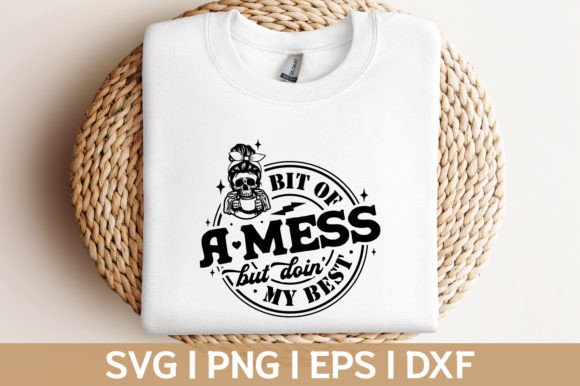
Bit of a Mess but Doin My Best Skeleton
First Impression Meets Studio Reality
When I unzipped the folder for Bit of a Mess but Doin My Best Skeleton, I immediately felt that mix of humor and honesty that sells so well in handmade spaces right now. This is not a polished, perfect character. The skeleton has personality built into every uneven line, and that is exactly what makes it work. The mood lands somewhere between cozy self-deprecation and quiet resilience, the kind of sentiment that resonates with buyers who are tired of overly cheerful or aggressively motivational designs. From a designer's perspective, the visual personality already does half the storytelling before a single stitch hits the fabric.
I pulled the design into my software and started thinking about how it would actually behave under a needle. The shape has a hand-drawn looseness that feels intentional, not sloppy. There is a wobble in the skeleton's posture that reads as endearing rather than poorly executed. For anyone in the craft business or running an Etsy seller shop, this kind of design bridges the gap between funny and wearable, which is a surprisingly hard balance to strike. Customers want something that makes them smile without feeling like a novelty item they will never actually use.
Where This Skeleton Belongs
I mentally placed Bit of a Mess but Doin My Best Skeleton on a dozen different products before I even opened my thread box. The first clear winner was a custom apparel piece, specifically a relaxed-fit sweatshirt in a soft oatmeal or dusty rose. The skeleton's informal line work would sit beautifully on a casual garment, and the phrase gives it that lived-in authenticity that customers connect with. I could also see this on a canvas tote bag design, where the larger surface area lets the details breathe without forcing the design into a cramped hoop space.
Another strong contender was an embroidered patch format. The slightly messy aesthetic actually forgives the small imperfections that can happen during patch production, which is a practical advantage for small shop product makers who need consistent results across multiple units. I also pictured this on a kitchen towel as a tongue-in-cheek hostess gift, or on a simple pillow cover for someone who appreciates home decor with a sense of humor. The skeleton's expression—or lack of one—keeps it versatile enough for personalized gift projects without locking you into a single holiday or season.
Stitching Reality Check
Here is where experience matters. A design that looks charming on screen can turn into a thread disaster if you do not think through the stitch density and fabric choices. The skeleton's thin arms and the lettering in Bit of a Mess but Doin My Best Skeleton need careful attention. I would recommend testing on a medium-weight cotton or a cotton-poly blend before committing to anything overly textured. Fabrics like terry cloth, fluffy fleece, or loose-weave linen can swallow the finer details, especially the small curves in the skeleton's hands and the slight irregularities in the text.
For sweatshirt embroidery, I always use a cutaway stabilizer and float a layer of water-soluble topping over any textured surface. This design would benefit from that extra step because the lettering has a wavy, hand-lettered feel that could lose clarity if the stitches sink into the fabric. On dark fabric, contrast becomes everything. A pale bone-white or soft cream thread for the skeleton against a charcoal or navy background would pop beautifully, but I would avoid light pastel threads on light backgrounds unless you are intentionally going for a subtle tone-on-tone look.
Small Details That Make or Break the Finish
I spent extra time zooming in on the skeleton's ribs and the slight tilt of the head. Those are the spots where satin stitch or fill stitch choices will either preserve the personality or flatten it into something generic. The original design has a sketch-like quality, and I would want to keep that energy in the finished product. If your embroidery software lets you adjust stitch angles, I would run a few test swatches with slightly different fill directions to see which one best captures the hand-drawn feel without creating unnecessary bulk.
One thing that stood out during my review was the skeleton's posture. There is a subtle slump to the shoulders that reads as tired but still trying. That emotional nuance is exactly what makes a design memorable for buyers browsing Etsy listings or craft fair products. It is not just a skeleton; it is a skeleton that feels like it has had a long week and is still showing up. Customers notice that. They comment on it. They gift it to friends who need that exact message.
Hoop Size and Placement Strategy
Before you start stitching, check your hoop size against the design's actual dimensions. I always recommend measuring twice and running a paper template placement test on the garment before hooping up. This is especially true for baby embroidery or smaller items like caps, where the design might need to be scaled down. If you scale too far, the skeleton's delicate lines could become too dense or lose legibility. A standard 4x4 or 5x7 hoop should handle the design comfortably for most embroidery project uses, but I would confirm exact dimensions from the file before assuming anything.
For curved surfaces like caps or structured hats, I would approach Bit of a Mess but Doin My Best Skeleton with caution. The horizontal layout of the text paired with the skeleton figure means you need a fairly flat stitching area. Caps with a prominent center seam can distort the design, and the lettering might warp around the curve. If you are determined to offer this on headwear, test it on a low-profile cap with minimal front structure and be prepared to adjust placement higher or lower than you initially expect.
Thread Colors and Contrast Decisions
I tested a few thread combinations in my head and on a quick mockup. A slightly off-white skeleton on a deep forest green background gave the design a vintage botanical feel that surprised me. A soft peach thread on natural linen made it feel almost delicate, which is a fun contrast to the slightly irreverent phrase. For handmade product sellers who want to stand out, experimenting with unexpected thread colors can turn a standard design into a signature piece. Just keep the text readable. If the phrase becomes hard to decipher, the whole design loses its impact.
I also recommend testing the design in black and white before finalizing any color decisions. A quick grayscale preview in your software reveals whether the skeleton and text maintain enough contrast to work on various backgrounds. If the design looks muddy in grayscale, it will likely feel flat on certain fabric colors. This is one of those small steps that separates a polished boutique branding product from something that looks like a hobbyist experiment.
Licensing and Commercial Use Considerations
Since the product description for Bit of a Mess but Doin My Best Skeleton comes from the Crafts and Graphics category, I want to address the business side directly. The listing mentions SVG and PNG files compatible with Cricut, Silhouette Studio, and Brother Scan N Cut, but I did not see explicit language about commercial embroidery licensing for finished products. If you plan to sell embroidered items featuring this design—whether on sweatshirts, tote bags, or digital embroidery file bundles—reach out to the seller and confirm the terms. Do not assume anything. A quick message now can save you from a copyright headache later.
For digital product sellers who want to use this in printable mockup previews or as part of a larger design assets collection, the same caution applies. The file format list suggests it is intended for cutting machines, so you may need to digitize the design for embroidery use yourself. If you are not comfortable with digitizing, factor that cost into your project planning. A well-digitized version of this skeleton will preserve the original's charm while making it stitch-ready for machine embroidery design production.
Real Project Scenario: The Custom Tote That Sold Out
Let me walk you through a realistic scenario. I recently prepared a small batch of canvas totes for a local pop-up market. The theme was self-care with a sense of humor, and I stitched Bit of a Mess but Doin My Best Skeleton onto a natural cotton tote in a warm charcoal thread. I used a medium-weight cutaway stabilizer and kept the stitch density moderate to avoid puckering on the canvas. The result was exactly what I hoped for: the skeleton looked hand-sketched, the text was crisp but not stiff, and the overall feel was approachable and genuine.
Customers reacted to it immediately. They picked it up, laughed, read the phrase out loud, and then tucked it under their arm like they had already decided to buy it. That is the kind of emotional engagement that translates into sales. The design did not need to be perfect to be effective. In fact, the slight messiness of the skeleton was the whole point, and the finished embroidery respected that instead of trying to clean it up. For small business owners and apparel decorators, that authenticity is what builds repeat customers and word-of-mouth referrals.
When to Skip This Design
There are projects where Bit of a Mess but Doin My Best Skeleton is not the right fit. I would avoid using it on thin fabric like lightweight jersey or sheer materials, where the stitch density could cause tunneling or distortion. I would also think twice before placing it on heavily layered garments with zippers, seams, or pockets that interrupt the stitching area. Baby clothes can work if the design is scaled appropriately and the stabilizer is secure, but I would avoid placing it on areas that stretch frequently, like onesie shoulders or leggings knees.
For items that need frequent washing, like kitchen towels or everyday apparel, I would run a wash test on a sample before committing to a full production batch. The skeleton's finer details could fray over time if the stitch density is not optimized for durability. That does not mean the design is fragile; it just means you need to do your homework, which is true for any embroidery file you plan to use commercially.
Final Practical Notes for Makers
Before you list a finished product featuring Bit of a Mess but Doin My Best Skeleton, photograph it in natural light against a simple background. The design's personality shines when the texture of the stitches is visible, and overly styled photos can hide the very details that make it appealing. If you are selling digital mockups, include a close-up that shows the thread texture and the fabric weave so buyers understand what they are getting.
For creative entrepreneurs and hobbyists alike, this design offers a lot of flexibility. It works for holiday gifts, everyday pick-me-ups, and boutique product lines that lean into honest, slightly gritty humor. The key is to test thoroughly, choose your materials wisely, and let the design's natural character do the heavy lifting. Bit of a Mess but Doin My Best Skeleton is not trying to be flawless, and that is precisely why it connects with people who are tired of chasing perfection in their own lives.