Dad Mom Baby Two Cats Embroidery Review
First Look at the Family Theme
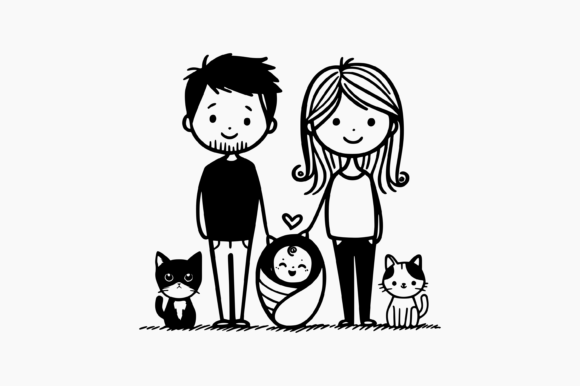
When I first opened the Dad Mom Baby Two Cats graphic, I felt an immediate warmth. The composition is intentionally simple, but the mood it creates is what stops you. It’s the kind of design that says home without being overly sentimental. The visual personality leans into a cozy, hand-drawn charm, with the family unit and two cats arranged in a balanced way that makes you smile before you even think about stitch types or hoop sizes. I knew right away this would fit into a project that needed a soft, approachable feel—something that speaks to new parents, cat lovers, or anyone who wants to celebrate the quiet chaos of a full household.
From a design reviewer’s perspective, the layout reads clearly. The shapes are distinct enough that you can mentally separate each element for multi-hooping or appliqué work, but they also hold together as one cohesive scene. There’s no visual clutter, and that’s a huge advantage when you’re thinking about how thread will build on fabric. I’ve seen plenty of family-themed designs get lost in tiny details, but this one keeps things readable. The cats are positioned naturally, not like an afterthought, and the human figures have a gentle, inclusive quality that avoids stiff outlines. For an embroidery digitizer, this is a forgiving starting point.
Where This Design Naturally Belongs
I’m mentally placing Dad Mom Baby Two Cats on a product right now. A soft, unbleached cotton tote bag comes to mind first—something a customer would carry to a farmer’s market or use as a reusable gift bag. The design would sit beautifully centered on the front panel, stitched in a muted palette of olive, rust, and cream. Another strong candidate is a lightweight sweatshirt, maybe for a family photoshoot or a cozy holiday gift. The theme also works effortlessly on a baby onesie, though you’d want to scale it down and simplify even further to keep the fabric from puckering. I could see it on a kitchen towel as a housewarming present, or on a pillow cover for a reading nook that already has a cat or two curled up nearby.
For small business owners, this design has cross-category flexibility. It fits into nursery decor, personalized gifts, wedding presents for couples who married into a blended family, and even pet memorial pieces if you quietly adjust the context. The emotional pull is broad enough to work in a boutique shop or an Etsy listing without feeling niche. I’ve learned that designs with this kind of gentle, everyday sentiment perform well year-round—they aren’t stuck in a single holiday window.
Thinking Through a Real Stitch-Out
Let me walk you through a real scenario. I’m prototyping a custom tote bag for a client who just had their first baby and already has two rescue cats. The Dad Mom Baby Two Cats graphic is downloaded as an SVG, and I’m bringing it into my digitizing software. Right away, I notice the lines are clean. The vector file gives me a crisp path to trace, which means I can generate a smooth satin stitch border without hours of manual node editing. The cut file format also means I can use it as a template for an appliqué base if I want to reduce stitch count and add fabric texture. I’ll probably run a test with a simple fill stitch on the figures and a running stitch for the cats’ whiskers, keeping the density low so the fabric remains soft.
I always test on the same fabric the final product will use. For the tote, that’s a medium-weight cotton canvas. I’ll baste a piece of scrap, hoop it with a medium cutaway stabilizer, and watch how the design registers. The cats’ tails and the baby’s small hands are the areas I’m paying closest attention to. If the stitch length is too short, those fine curves will turn into a stiff, raised ledge instead of a gentle contour. I’ll adjust the pull compensation slightly, because the overall shape is organic and forgiving—a tiny shift won’t ruin the illusion. After the first stitch-out, I’ll flip the fabric, check for thread breaks on the back, and decide if I need to enlarge the whole design by 10% to give the small details room to breathe.
What Works and What Needs a Careful Hand
The charm of Dad Mom Baby Two Cats lies in its simplicity, but that simplicity also means you have to be deliberate about color choices. On a light fabric, a dark charcoal thread for the outlines will make the design pop without making it look heavy. On a dark fabric, you’ll need to either invert the palette or use a lighter fill inside the figures so the family doesn’t disappear. I tested a black and white mockup on my screen, and the contrast held up well because the composition has enough negative space between the characters. That’s a good sign—it means the design won’t turn into a blob when viewed from a distance.
However, I’d be cautious about using this on highly textured fabrics like a chunky knit or terry cloth. The small areas, like the baby’s facial features or the thin lines of the cat whiskers, can distort easily. If you’re planning to put this on a curved surface like a cap, you’ll need to split the design or use a cap-specific hoop and adjust the arc. The family sits in a horizontal line, so it will naturally curve with the cap’s crown, but the baby and cats at the edges might get pulled out of alignment if you’re not meticulous about placement. I’d recommend a patch instead—stitch it on a flat piece of twill, then attach it to the hat. That gives you a cleaner finish and lets you control the tension.
Frequent washing is another consideration. If you’re embroidering on a baby blanket or a tea towel, use a soft polyester thread that won’t shrink or bleed. The satin stitch borders should be set at a width that won’t snag in the wash. I’d go with a width of about 2.5mm for the outlines, and I’d avoid a dense tatami fill on the larger shapes—keep it around 4.0 stitches per millimeter to maintain a soft hand. Nobody wants a stiff patch on a blankie meant for a newborn.
How It Elevates a Handmade Product
When a customer sees a finished tote or sweatshirt with Dad Mom Baby Two Cats on it, the first thing they’ll notice is the emotional recognition. This isn’t just a generic family silhouette; the two cats make it personal. I’ve seen similar designs in boutique shops, and the ones that include pets always sell faster because they tap into a specific story. The design adds perceived value to the product—it feels like it was made for someone’s actual life, not just a mass-produced template. For a small business, that kind of connection builds trust and repeat customers.
From a buyer engagement standpoint, the clear, readable graphic makes it easy to photograph for an Etsy listing. You can stage it on a neutral background, and the shapes hold up well in a thumbnail. The whimsical mood translates instantly, which means less copywriting to explain the product. I’ve learned that designs with this kind of instant readability get more clicks and fewer “what does it say?” questions. It also works beautifully in a printed mockup if you’re selling the embroidery as a finished item rather than a digital file.
Practical Notes for Embroidery Designers
If you’re planning to digitize Dad Mom Baby Two Cats for machine embroidery, take the time to review the original graphic carefully. The SVG and EPS files are your best friends here—they give you scalable vectors that won’t pixelate when you enlarge them. I’d open the file in a vector editor first and clean up any hidden nodes or overlapping lines that might confuse the auto-digitizing tool. Even though the overall shape is simple, auto-digitizing can still produce unnecessary jump stitches. Manual digitizing is always my preference for a design like this, especially to control the start and end points of the cats’ tails so they look natural, not chopped off.
Thread color testing is non-negotiable. I usually run three variations: one with a matching thread palette, one with a high-contrast outline, and one with a tonal, tone-on-tone look. For a baby item, the tonal version often wins because it feels softer. For a tote bag, I’ll go with the contrast version to make it pop. Check your stitch density on a scrap of the actual fabric, and always wash the test piece once before you commit to a full production run. You’d be surprised how a fill stitch can shift after a warm wash cycle.
Hoop size is another detail you’ll need to confirm. The graphic is scalable, but for a clean stitch-out, I’d aim for a finished design width of at least 4 inches so the baby and cats don’t become a mess of tiny satin stitches. If your hoop is limited to a 4x4, you might need to reduce the detail or split the design into two hoopings. I’d rather enlarge the design and use a larger hoop than force it into a small space and lose the charm. Always check the actual stitch simulation in your software—what looks fine on a screen might be too dense in reality.
Commercial licensing is the final piece. The product description says SVG, PNG, EPS, DXF cut files, but it doesn’t specify the license terms. I always reach out to the seller or read the included license file before I stitch this on anything I plan to sell. Can you use it on finished physical products? Can you sell the digitized embroidery file? Those are separate permissions. I’d never assume a commercial license is included just because it’s a digital download. Clarify that first, especially if you’re building a product line around this theme.
Final Thoughts Before You Stitch
Dad Mom Baby Two Cats is the kind of design that quietly does its job. It’s not flashy, and it doesn’t need to be. For an embroidery business, it’s a reliable, emotionally resonant graphic that translates well to fabric if you treat it with the care it deserves. The vector files give you flexibility, and the theme gives you a wide audience. I’d feel confident showing a finished sample to a client, knowing the reaction would be less about the stitching and more about the story it tells. That’s the mark of a good design asset—it becomes a small, stitched moment of recognition.
Just remember to test everything on your own setup. What works on my single-needle machine with a 5x7 hoop might need tweaking on a multi-needle or a different stabilizer combination. The design is forgiving, but embroidery always has a learning curve. Once you dial it in, though, you’ll have a product that people want to gift, wear, and display. And that’s the whole point of putting thread to fabric.